|
In the best way of contemporary poets who work in form, Laura Maffei has taken the tanka and made it her own. This collection functions as a poignant yet clear-eyed memoir in tanka, juxtaposing the sensual with the workaday, mordant social commentary with the hope — and sometimes the reality — of ferocious intimacy. The poet writes: ‘my neighbor/ plays his guitar/ through the wall/and I am three chords/ less lonely’; having recognized our own complicated experiences in these poems, we too come away from this collection feeling both imagistically satisfied and much less lonely.
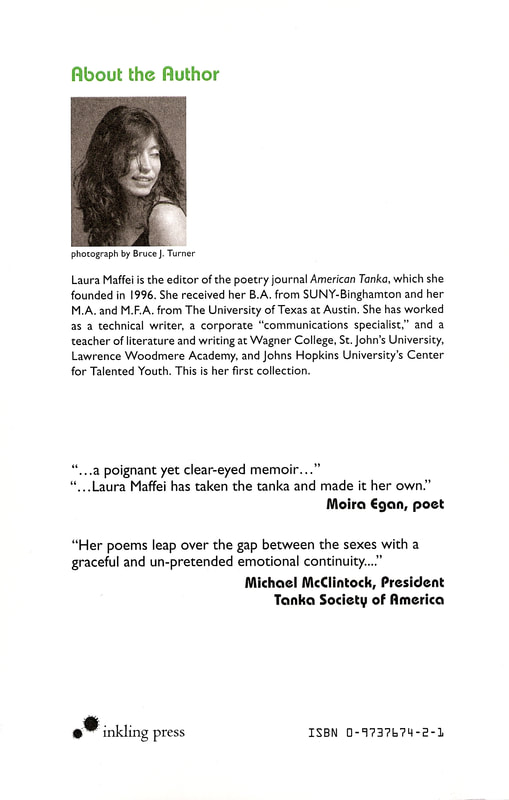
— Moira Egan, author of Cleave, Bar Napkin Sonnets, Spin, Hot Flash Sonnets, and Synaesthesium Her poems leap over the gap between the sexes with a graceful and un-pretended emotional continuity […] Here, in Maffei’s world, diet books and bug spray, apartments and snaking traffic, single packets of Caesar salad dressing, malls and fridges, and the unforgettable ‘infant Batman,’ are the fingerprints of time and place. How extraordinarily well Maffei has captured and enlarged them, making them reveal to us our world and her world, opening to us her life as a woman, friend, wife, lover, teacher, poet, and ‘girl/with a strong squeeze.’ — from the Afterward by Michael McClintock (President of the Tanka Society of America A long-time editor of one of the best tanka journals in North America, American Tanka, Ms Maffei holds a B.A. from SUNY-Binghamton and M.A. and MFA from the University of Texas at Austin. She has worked as a technical writer, a corporate “communications specialist,” and a teacher of literature and writing at various US colleges and universities. No denizen of the musty stacks, however, Ms. Maffei is a poet of the quotidian, the domestic; a poet of nature and relationships. Her mastery of the form allows her to pare the traditional 5-7-5-7-7 syllable pattern down to an even more abbreviated poem, and she likes to experiment with the distribution of stress and placement of long and short lines. Likewise, she often abandons the bipartite construction familiar to readers of haiku and senryu, in favor of continuous syntax. In each poem, however, she delivers an extreme close-up or bon mot or subtle surprise that makes us smile in recognition: my neighbour plays his guitar through the wall and I am three chords less lonely (p. 84) how much laundry is too much? the dark tangle of many sleeves inside the machine (p. 46) That second tanka could almost be an ars poetica: the movement from literal image to metaphor is subtle and arresting, invites many interpretations. Vive the extra two lines on the haiku, I say. Sometimes it allows the poet that little extra breathing space and those precious extra words, so that she’s not forced to squeeze an epiphany out of the juxtaposition of meagre phrase and fragment; sometimes, however, she achieves the concision of haiku regardless: gravestones in a new cemetery how deeply each letter of each name is cut (p. 89) The poet’s line breaks, rhythmic control, and timing are impeccable. The book is divided into five sections: “Office Job,” “Infant Batman,” “One Leg Unshaved,” “Chalk Dust,” and “Summer of Nipples.” Together, as one critic has pointed out, they comprise a memoir of sorts. Nice trick that. I suspect the poet has done a lot of winnowing to come up with such a gallery of telling portraits. – Richard Stevenson, “Three Books From Inkling Press,” PoetryReviews.ca Well over a hundred tanka from the editor of American Tanka, with one or two pieces per page. There is an interesting, eclectic array of tanka, with affectionate glimpses of visits to the poet’s parents, her life with her husband, the hours at the office and many other themes. There are some excellent observational pieces, as is shown by this finely-drawn one, with its enviable tightness and succinctness: sunny day unexpectedly a hearse in my rear-view mirror and the long line behind it Here is another graphic example, which captures the described situation so ably: how my tongue is tied years after graduation trying to speak well over the telephone with an old professor Where Laura Maffei is particularly good is in her acute observation of women; here are three representative examples: on the walk home the woman in front of me has the slit of her skirt and the slit of her slip lined up perfectl that woman’s fashionable brown shoes the redness where they’re cutting her just above the instep women our handbags touching as we jostle each other down the ferry steps — Alan Hardy, New Hope International, December 14, 2007 |
